The TRY /KRW chart looks like a great buy. But and hold a few years. How low could the lira possibly go?
Saturday, November 18, 2017
Friday, November 17, 2017
Industrial Demand for Gold
Industrial Demand for Gold could be one of the increasingly more important sources of demand in the future.
Various technologies, like gold nano particles and micro chips, are increasingly using gold. Gold has many positive chemical properties, including non-reactivity.
https://www.forbes.com/sites/oliviergarret/2017/05/10/could-breakthrough-cancer-treatments-raise-industrial-gold-demand/#60a813103c5c
Overall gold demand was down by 9% year over year, to 915 tonnes. But I think it's just a question of time until it picks up. Feel comfortable with holding gold miners long term.
Gold - Commitment of Traders
Commitment of Traders is still not very constructive for Gold. At least the small speculators have pulled back a little bit. But overall, not very supportive of a move higher any time soon. That's a bit worrisome. But let's see how it goes.
Sunday, January 15, 2017
Back Again... Hopefully for Good.
Apologies again for my absence, if you have been reading this blog and hoping for any updates or hoping to hear my thoughts about market movements.
From the investment perspective, I'm glad to say that I've reached my basic retirement goal. I achieved it in early 2016 (February?). Let's hope for more in 2017.
I've been out of work in the past few months due to health and personal matters. But I'm getting better now. During my rest period, I've been able to take stock of my portfolio, inventoried various investment options available for me here in Korea, and assess the market situation in equities, commodities and currencies.
The equity and commodity markets have generally run up since Trump's election and they look like they are getting a bit stretched--but maybe they are stretched because of the promise of fiscal stimulus by Trump and elsewhere in the world, which is helping to underpin.
Equities: I'll be looking to take some equity fund profits soon. S&P at 2275 now. I'll probably take some equity fund exposure off the table around S&P 2300 (KOSPI 2100?), though I feel it can eventually reach 2400. Samsung Electronics (KOSPI bellwether) looks very stretched. Time to "peel back" some exposure soon. Maybe sell a bit or all of EWI (Italy).
Commodities: Commodities have run up, including gold. I think oil (XOI) and metals can continue to climb a bit more. Gold looks good to run a bit for now, especially the COT picture. My newer positions in Gold are still underwater, but my old position should be sellable at a very nice profit. Hopefully, I'll be able to trade out of at least some of my newer positions. Gold miners a partial sell at around 50 day moving average (218)? Maybe a bit above? Sell ILF (Latin America) to take profits as the chart looks mixed now.
Currencies: I sold some USDs around 1200 and a bit below. Now KRW is starting to rebound. Might go to 1150? AUD/KRW looks like it might climb above 880--sell AUD at around 890 or sooner? Sell ZAR soon (when selling gold miners?) ZAR/KRW at 87 now. I bought ZAR at 76. Time to sell ZAR between 87-90?
What looks good from the chart perspective--Mexican Peso, Turkey Lira (glad I added some Lira at 303 to KRW, but damned lady at Hana Bank gave me an incorrect quote). Japanese equities--nibble on any large drop as Yen still looks like it might eventually get to 120. GBP might have one more sell off or plunge in it as rumors of Hard Brexit are heating up and not even Trump's willingness to do a quick trade deal seems to be helping to bolster it much. I'd be interested in buying between 1.20 to 1.10. The lower the better. At 1418 GBP/KRW and 1.203 GBP/USD now.
What doesn't look good--Korean Healthcare fund. MYR. Chinese equities (but not Hang Seng). And I'll probably need smarts not to take a loss on some of my gold miner exposure. But so far, so good as it's climbing back up...
What looks uncertain--Euro and EU. And now, EU has Trump as an avowed enemy. Not good.
From the investment perspective, I'm glad to say that I've reached my basic retirement goal. I achieved it in early 2016 (February?). Let's hope for more in 2017.
I've been out of work in the past few months due to health and personal matters. But I'm getting better now. During my rest period, I've been able to take stock of my portfolio, inventoried various investment options available for me here in Korea, and assess the market situation in equities, commodities and currencies.
The equity and commodity markets have generally run up since Trump's election and they look like they are getting a bit stretched--but maybe they are stretched because of the promise of fiscal stimulus by Trump and elsewhere in the world, which is helping to underpin.
Equities: I'll be looking to take some equity fund profits soon. S&P at 2275 now. I'll probably take some equity fund exposure off the table around S&P 2300 (KOSPI 2100?), though I feel it can eventually reach 2400. Samsung Electronics (KOSPI bellwether) looks very stretched. Time to "peel back" some exposure soon. Maybe sell a bit or all of EWI (Italy).
Commodities: Commodities have run up, including gold. I think oil (XOI) and metals can continue to climb a bit more. Gold looks good to run a bit for now, especially the COT picture. My newer positions in Gold are still underwater, but my old position should be sellable at a very nice profit. Hopefully, I'll be able to trade out of at least some of my newer positions. Gold miners a partial sell at around 50 day moving average (218)? Maybe a bit above? Sell ILF (Latin America) to take profits as the chart looks mixed now.
Currencies: I sold some USDs around 1200 and a bit below. Now KRW is starting to rebound. Might go to 1150? AUD/KRW looks like it might climb above 880--sell AUD at around 890 or sooner? Sell ZAR soon (when selling gold miners?) ZAR/KRW at 87 now. I bought ZAR at 76. Time to sell ZAR between 87-90?
What looks good from the chart perspective--Mexican Peso, Turkey Lira (glad I added some Lira at 303 to KRW, but damned lady at Hana Bank gave me an incorrect quote). Japanese equities--nibble on any large drop as Yen still looks like it might eventually get to 120. GBP might have one more sell off or plunge in it as rumors of Hard Brexit are heating up and not even Trump's willingness to do a quick trade deal seems to be helping to bolster it much. I'd be interested in buying between 1.20 to 1.10. The lower the better. At 1418 GBP/KRW and 1.203 GBP/USD now.
What doesn't look good--Korean Healthcare fund. MYR. Chinese equities (but not Hang Seng). And I'll probably need smarts not to take a loss on some of my gold miner exposure. But so far, so good as it's climbing back up...
What looks uncertain--Euro and EU. And now, EU has Trump as an avowed enemy. Not good.
Tuesday, July 17, 2012
VIX to 15 or Below a Good Bet
I'm thinking that VIX going to 15 or below looks like a good bet. That would be part of the topping process similar to last year. It might even stay around 15 or below for a week or two.
Sunday, July 15, 2012
BACK!
I AM BACK!
Thank you everyone who visited my blog during the last several years and apologies for the long absence. The primary reason for my absence was my work and personal life. During the financial crisis which was beginning around the time I last posted, my job situation wasn't easy. At times, I was very busy with work. At other times, I was anxiously worried that I didn't have any work and wasn't in a mood to really post. I wish I could say that I hit a jackpot during the financial crisis with my investments. The truth is that I more or less broke even. That's actually still not bad, considering the losses that some people took.
My best trade during that period was the time that I stalked and anticipated almost to the minute, the top in oil at around $147 per barrel, and went long some airlines for huge gains in the next 2 or 3 days. I didn't invest enough (a mistake I've made too often) and exited the trade too early, but still made a hefty sum, maybe $50,000.
Not too long thereafter, as the shi* started to hit the fan, in one account, I get out of gold mining stocks shortly after they started to tank, taking a stinging loss, but definitely avoiding the worst of it. Thereafter, I made some short term trades in financial ETFs, sometimes shorting, sometimes going long, which together probably netted out to around break even. I remember one episode when I left several thousand dollars on the table because there was a technical problem with Fidelity not executing my trade for a good hour or so. Frustrating to say the least.
In a second main account, I took losses in Asian funds as the crisis began to take hold. I remember taking particularly bad losses in Chinese and Japanese funds, though the amounts at stake weren't overly huge in relative speaking. I also took steep paper losses in this account in my gold mining shares, investing in the Black Rock managed World Gold Fund. In this account, I decided to ride out the crisis with my gold mining positions intact. It was a disaster at the beginning, but eventually, the position went back to positive, and then soared into profit, as gold miners rose sharply after all the stimulus injected by governments and central banks. One mistake I may have made was not selling the investment earlier because I actually had a currency gain (with the fund being denominated in USDs) relative to my home base currency which actually outstripped my gain in the miners themselves. I remember at one point I had a gain of over 50% considering capital appreciation and currency gains. Eventually, I sold the position for something like a 30% net gain. Still not bad, but again left some money on the table.
As the economy started to bottom out, one of my better ideas was to close my fidelity account and repatriate most of my funds from an account in the U.S. back to my base country. Overall, I only had a very modest gain overall from this account, but I felt it was decent enough. Unfortunately, it took me well over a month to succeed in doing it because Citibank, where I had my funds, was very uncooperative and imposed hurdle after hurdle. If I had been able to do it on the day of my decision, I would have benefited from a cross exchange rate of 1250 per USD. Instead, by the time I was actually able to overcome all the red tape and hurdles, I could only get 1185 to 1190. That was around USD 435,000 repatriated. I rode my base currency all the way down to 1050 or so, at which point I bought some USD for a nifty swing trade, selling them at around 1120--if only I had bought more! The currency currently sits at 1146.
My mistake during the recovery was being initially too tentative in getting back into the market. I remember going to the bank to buy some Korea funds at the height of the crisis (i.e., near the bottom) and the bank teller literally scaring me into taking a smaller position than I had initially wanted ("don't invest too much.. who knows what could still happen to GM!"). Then of course, I sold too early and watched from the side as world stock markets continued to advance for months.
After the last major pullback last September or so, I started to buy back in. I was a little bit too early again, but I was convinced by certain analysis by Adam Hamilton of http://www.zealllc.com/ that the September highs were not a market top. It wasn't easy being long with all this bad news in the press, with Europe being of course the most prominent. But it turned out that Mr. Hamilton was correct and, by extension, so was I.
But several factors limited the gains that I made. First, misallocation among markets. I should have been investing in the U.S., the indices of which had the most bullish postures. Instead, I concentrated in Asia. The Korea funds generally did ok and I sold them at various times for approximately between 5% and 20% gains. Japan also rallied sharply after lagging for a while following the earthquake/tsunami (in which I had the misfortune to participate as an investor in a Japanese fund). I sold my Japanese positions for around 10% gains. But China continued to underpeform and in the end, although I sold at a relative high, I had to take a 8% loss on a position of around $200,000, which definitely put a damper on my gains. Another reason was fund underperformance. Some of the funds definitely underperformed, including one Korean fund in which I had doubled down right after the death of Kim Il Sung which I knew to be, and was proven correct, to be a significant buying opportunity. I think I sold that one at under 5% gain, which was a shame because my decision to invest right after the death of Dear Leader was one that would have been probably considered to have been rather risky at the time. I wish the risk could have been appropriately rewarded, but instead the incompetent fund manager screwed me.
Overall, doubling down on Japan right after the tsunami, and adding more to my Korean holdings following the death of Dear Leader, were good decisions on my part, but investing straight up in the U.S. (possibly with currency hedge) would have been even better, so my gains lagged those of the S&P.
And now, I come to the current situation. One of my mistakes was getting back into gold miners too early after gold topped out last year at over $1900. I've been since adding to a position that has come under water and remained under water for quite some time. I still continue to think it's a sound bet, and that gold miners are particularly undervalued relative to the price of gold. Further, I think that sentiment among gold investors is very bad, which is a good contrarian signal. Still, I'm pretty sure there will be at least one more scary shakeout before the miners can start on an uptrend, though the bottoming process may have started already. I'm looking to add slightly to my position later in July if gold takes another hit. I'll be carefully watching the support between $1550 and $1530 or so.
I like the recent quote from Mark Hulbert of MarketWatch: "Gold-market contrarians these days must be feeling like the card counter in blackjack who knows that the odds are in his favor—provided he continues to play rationally. But beads of sweat are definitely visible on his brow."
Other than that, I have a small leveraged position in Korea stock funds and have been slowly accumulating USD while selling my base currency. I believe that world markets are getting close to topping (in fact, they most likely already topped out when the S&P reached over 1400, but one more push to around that level might not be out of the question), though VIX will still again fall to or below 15 and might stay there for a little bit before we get a significant downdraft. In summary, I see both my long Korea stocks position and my USD hedging position working out fairly soon. Selling off my Korea funds in the coming days for a small profit and adding to my USD hedge seems like a sound idea while keeping my fingers crossed on gold in the coming days/weeks.
What will happen once the markets top? It's hard to say. I don't see another major bear market that takes the S&P below 1000 just yet, though a significant and painful downdraft could definitely be in the cards before the coming election in November--such sell off, which I see as likely in the coming few months, would definitely strongly undermine Obama's reelection chances. After I think the markets will try to muddle through. Hopefully the Fed will step up to the plate and add some support soon, which will help to keep the bottom from completely falling out, while giving a major boost to gold stocks.
My goal remains the same: to soon retire and concentrate on my interests, including my investments.
Thank you everyone who visited my blog and apologies for the long absence. The primary reason for my absence was my work and personal life. During the financial crisis which was beginning around the time I last posted, my job situation wasn't easy. At times, I was very busy with work. At other times, I was anxiously worried that I didn't have any work and wasn't in a mood to really post. I wish I could say that I hit a jackpot during the financial crisis with my investments. The truth is that I more or less broke even. That's actually still not bad, considering the losses that some people took.
My best trade during that period was the time that I stalked and anticipated almost to the minute, the top in oil at around $147 per barrel, and went long some airlines for huge gains in the next 2 or 3 days. I didn't invest enough and exited the trade too early, but still made a hefy sum.
Not too long thereafter, as the shi* started to hit the fan, in one account, I get out of gold mining stocks shortly after they started to tank, taking a stinging loss, but definitely avoiding the worst of it. Thereafter, I made some short term trades in financial ETFs, sometimes shorting, sometimes going long, which together probably netted out to around break even. I remember one episode when I left several thousand dollars on the table because there was a technical problem with Fidelity not executing my trade for a good hour or so. Frustrating to say the least.
In a second main account, I took losses in Asian funds as the crisis began to take hold. I remember taking particularly bad losses in Chinese and Japanese funds, though the amounts at stake weren't overly huge in relative speaking. I also took steep paper losses in this account in my gold mining shares, investing in the Black Rock managed World Gorld Fund. In this account, I decided to ride out the crisis with my gold mining positions intact. It was a disaster at the beginning, but eventually, the position went back to positive, and then soared into profit, as gold miners rose sharply after all the stimulus injected by governments and central banks. One mistake I may have made was not selling the investment earlier because I actually had a currency gain (with the fund being denominated in USDs) relative to my home base currency which actually outstripped my gain in the miners themselves. I remember at one point I had a gain of over 50% considering capital appreciation and currency gains. Eventually, I sold the position for something like a 30% net gain. Still not bad, but again left some money on the table.
As the economy started to bottom out, one of my better ideas was to close my fidelity account and repatriate most of my funds from an account in the U.S. back to my base country. Overall, I only had a very modest gain overall from this account, but I felt it was decent enough. Unfortunately, it took me well over a month to succeed in doing it because Citibank, where I had my funds, was very uncooperative and imposed hurdle after hurdle. If I had been able to do it on the day of my decision, I would have benefited from a cross exchange rate of 1250 per USD. Instead, by the time I was actually able to overcome all the red tape and hurdles, I could only get 1185 to 1190. That was around USD 435,000 repatriated. I rode my base currency all the way down to 1050 or so, at which point I bought some USD for a nifty swing trade, selling them at around 1120--if only I had bought more! The currency currently sits at 1146.
My mistake during the recovery was being initially too tentative in getting back into the market. I remember going to the bank to buy some Korea funds at the height of the crisis (i.e., near the bottom) and the bank teller literally scaring me into taking a smaller position than I had initially wanted ("don't invest too much.. who knows what could still happen to GM!"). Then of course, I sold too early and watched from the side as world stock markets continued to advance for months.
After the last major pullback last September or so, I started to buy back in. I was a little bit too early again, but I was convinced by certain analysis by Adam Hamilton of www.zealllc.com that the September highs were not a market top. It wasn't easy being long with all this bad news in the press, with Europe being of course the most prominent. But it turned out that Mr. Hamilton was correct and, by extension, so was I.
But several factors limited the gains that I made. First, misallocation among markets. I should have been investing in the U.S., the indices of which had the most bullish postures. Instead, I concentrated in Asia. The Korea funds generally did ok and I sold them at various times for approximately between 5% and 20% gains. Japan also rallied sharply after lagging for a while following the erarthquake/tsunami (in which I had the misfortune to participate as an investor in a Japanese fund). I sold my Japanese positions for around 10% gains. But China continued to underpeform and in the end, although I sold at a relative high, I had to take a 8% loss on a position of around $200,000, which definitely put a damper on my gains. Another reason was fund underperformance. Some of the funds definitely underperformed, incluidng one Korean fund in whcih I had doubled down right after the death of Kim Il Sung which I knew to be, and was proven correct, to be a significant buying opportunity. I think I sold that one at under 5% gain, which was a shame because my decision to invest right after the death of Dear Leader was one that would have been probably considered to have been rather risky at the time.
Overall, doubling down on Japan right after the tsunami, and adding more to my Korean holdings following the death of Dear Leader, were good decisions on my part, but investing straight up in the U.S. (wpossibly with currency hedge) would have been even better, so my gains lagged those of the S&P.
And now, I come to the current situation. One of my mistakes was getting back into gold miners too early after gold topped out last year at over $1900. I've been since adding to a position that has come under water and remained under water for quite some time. I still continue to think it's a sound bet, and that gold miners are particularly undervalued relative to the price of gold. Further, I think that sentiment among gold investors is very bad, which is a good contrarian signal. Still, I'm pretty sure there will be at least one more scary shakeout before the miners can start on an uptrend, though the bottoming process may have started already. I'm looking to add slightly to my position later in July if gold takes another hit. I'll be carefully watching the support between $1550 and $1530 or so.
I like the recent quote from Mark Hulbert of MarketWatch: "Gold-market contrarians these days must be feeling like the card counter in blackjack who knows that the odds are in his favor—provided he continues to play rationally. But beads of sweat are definitely visible on his brow."
Other than that, I have a small leveraged position in Korea stock funds and have been slowly accumulating USD while selling my base currency. I believe that world markets are getting close to topping (in fact, they most likely already topped out when the S&P reached over 1400, but one more push to around that level might not be out of the question), though VIX will still again fall to or below 15 and might stay there for a little bit before we get a significant downdraft. In summary, I see both my long Korea stocks position and my USD hedging position working out fairly soon. Selling off my Korea funds in the coming days for a small profit and adding to my USD hedge seems like a sound idea.
My best trade during that period was the time that I stalked and anticipated almost to the minute, the top in oil at around $147 per barrel, and went long some airlines for huge gains in the next 2 or 3 days. I didn't invest enough and exited the trade too early, but still made a hefy sum.
Not too long thereafter, as the shi* started to hit the fan, in one account, I get out of gold mining stocks shortly after they started to tank, taking a stinging loss, but definitely avoiding the worst of it. Thereafter, I made some short term trades in financial ETFs, sometimes shorting, sometimes going long, which together probably netted out to around break even. I remember one episode when I left several thousand dollars on the table because there was a technical problem with Fidelity not executing my trade for a good hour or so. Frustrating to say the least.
In a second main account, I took losses in Asian funds as the crisis began to take hold. I remember taking particularly bad losses in Chinese and Japanese funds, though the amounts at stake weren't overly huge in relative speaking. I also took steep paper losses in this account in my gold mining shares, investing in the Black Rock managed World Gorld Fund. In this account, I decided to ride out the crisis with my gold mining positions intact. It was a disaster at the beginning, but eventually, the position went back to positive, and then soared into profit, as gold miners rose sharply after all the stimulus injected by governments and central banks. One mistake I may have made was not selling the investment earlier because I actually had a currency gain (with the fund being denominated in USDs) relative to my home base currency which actually outstripped my gain in the miners themselves. I remember at one point I had a gain of over 50% considering capital appreciation and currency gains. Eventually, I sold the position for something like a 30% net gain. Still not bad, but again left some money on the table.
As the economy started to bottom out, one of my better ideas was to close my fidelity account and repatriate most of my funds from an account in the U.S. back to my base country. Overall, I only had a very modest gain overall from this account, but I felt it was decent enough. Unfortunately, it took me well over a month to succeed in doing it because Citibank, where I had my funds, was very uncooperative and imposed hurdle after hurdle. If I had been able to do it on the day of my decision, I would have benefited from a cross exchange rate of 1250 per USD. Instead, by the time I was actually able to overcome all the red tape and hurdles, I could only get 1185 to 1190. That was around USD 435,000 repatriated. I rode my base currency all the way down to 1050 or so, at which point I bought some USD for a nifty swing trade, selling them at around 1120--if only I had bought more! The currency currently sits at 1146.
My mistake during the recovery was being initially too tentative in getting back into the market. I remember going to the bank to buy some Korea funds at the height of the crisis (i.e., near the bottom) and the bank teller literally scaring me into taking a smaller position than I had initially wanted ("don't invest too much.. who knows what could still happen to GM!"). Then of course, I sold too early and watched from the side as world stock markets continued to advance for months.
After the last major pullback last September or so, I started to buy back in. I was a little bit too early again, but I was convinced by certain analysis by Adam Hamilton of www.zealllc.com that the September highs were not a market top. It wasn't easy being long with all this bad news in the press, with Europe being of course the most prominent. But it turned out that Mr. Hamilton was correct and, by extension, so was I.
But several factors limited the gains that I made. First, misallocation among markets. I should have been investing in the U.S., the indices of which had the most bullish postures. Instead, I concentrated in Asia. The Korea funds generally did ok and I sold them at various times for approximately between 5% and 20% gains. Japan also rallied sharply after lagging for a while following the erarthquake/tsunami (in which I had the misfortune to participate as an investor in a Japanese fund). I sold my Japanese positions for around 10% gains. But China continued to underpeform and in the end, although I sold at a relative high, I had to take a 8% loss on a position of around $200,000, which definitely put a damper on my gains. Another reason was fund underperformance. Some of the funds definitely underperformed, incluidng one Korean fund in whcih I had doubled down right after the death of Kim Il Sung which I knew to be, and was proven correct, to be a significant buying opportunity. I think I sold that one at under 5% gain, which was a shame because my decision to invest right after the death of Dear Leader was one that would have been probably considered to have been rather risky at the time.
Overall, doubling down on Japan right after the tsunami, and adding more to my Korean holdings following the death of Dear Leader, were good decisions on my part, but investing straight up in the U.S. (wpossibly with currency hedge) would have been even better, so my gains lagged those of the S&P.
And now, I come to the current situation. One of my mistakes was getting back into gold miners too early after gold topped out last year at over $1900. I've been since adding to a position that has come under water and remained under water for quite some time. I still continue to think it's a sound bet, and that gold miners are particularly undervalued relative to the price of gold. Further, I think that sentiment among gold investors is very bad, which is a good contrarian signal. Still, I'm pretty sure there will be at least one more scary shakeout before the miners can start on an uptrend, though the bottoming process may have started already. I'm looking to add slightly to my position later in July if gold takes another hit. I'll be carefully watching the support between $1550 and $1530 or so.
I like the recent quote from Mark Hulbert of MarketWatch: "Gold-market contrarians these days must be feeling like the card counter in blackjack who knows that the odds are in his favor—provided he continues to play rationally. But beads of sweat are definitely visible on his brow."
Other than that, I have a small leveraged position in Korea stock funds and have been slowly accumulating USD while selling my base currency. I believe that world markets are getting close to topping (in fact, they most likely already topped out when the S&P reached over 1400, but one more push to around that level might not be out of the question), though VIX will still again fall to or below 15 and might stay there for a little bit before we get a significant downdraft. In summary, I see both my long Korea stocks position and my USD hedging position working out fairly soon. Selling off my Korea funds in the coming days for a small profit and adding to my USD hedge seems like a sound idea.
Wednesday, December 05, 2007
Precious Metals Market Roundup
Some recent news items that caught my eye:
1. NovaGold (NG)'s stock price was cut in half in one day after NG announced that estimated mine construction costs at its Galore Creek project would be around $5 billion, up from the $2 billion previous estimated at the time of the feasibility study. I bet some NG shareholders must be regretting not tendering their shares to Barrick. Although NG's joint venture partner in the project, Teck Cominco (TCK) agreed to spend more money to investigate the viability of the project, apparently, Clive Maund recently warned that NG may possibly end up being delisted. I bet Barrick execs must be snickering in delight... but probably not too loudly because NG and Barrick recently agreed to put their differences in the past regarding the development of their joint Donlin Creek project, which reportedly contains around 30 million ounces of gold reserves.
Actually, the Galore Creek news is generally bullish for Gold prices, because it raises the specter that not as many gold mining projects may be coming on line as previously expected and highlights again the tremendous cost pressures faced by the industry which should help to keep a floor for the gold price.
2. It appears that OPEC won't raise oil output until at least January. That may help to keep a floor for oil prices. This may be partly offset, at least in the short term, by the fact that a U.S. intelligence report was recently released stating that Iran has had no weapons of mass destruction program since 2003. Another embarrassing blow for the Bush administration and for U.S. foreing policy. Iran will probably be emboldened by this development, already saying that it amounted to a "declaration of victory" for Iran. As a result, I would not expect oil prices to slide too low on this news as it will probably put the U.S. on an even firmer collision course with Iran. Condi Rice was quoted as saying "that frankly is good news", in a laughably glib response to the intelligence release.
3. Rob McEwen, Chairman and CEO of US Gold Corp (UXG) exercised warrants to increase his shareholding in UXG to 21.5% in a likely effort to shore up UXG's falling share price. Some shareholders have likely been concerned by what appears to be a management shakeup recently at UXG. I would not bet against Mr. McEwen however. In a sector where good management is quite hard to find, I believe that Mr. McEwen is one of the best. UXG may be enjoying a washout bottom on huge volume the last couple of days.
4. This was announced on November 6, but only recently caught my eye: GSS's total cash costs were an awe-inspiring $707 for Q3, accoridng to GSS's Q3 report in which they announced another loss to the tune of $12.7 million. $707! Unbelievable...
1. NovaGold (NG)'s stock price was cut in half in one day after NG announced that estimated mine construction costs at its Galore Creek project would be around $5 billion, up from the $2 billion previous estimated at the time of the feasibility study. I bet some NG shareholders must be regretting not tendering their shares to Barrick. Although NG's joint venture partner in the project, Teck Cominco (TCK) agreed to spend more money to investigate the viability of the project, apparently, Clive Maund recently warned that NG may possibly end up being delisted. I bet Barrick execs must be snickering in delight... but probably not too loudly because NG and Barrick recently agreed to put their differences in the past regarding the development of their joint Donlin Creek project, which reportedly contains around 30 million ounces of gold reserves.
Actually, the Galore Creek news is generally bullish for Gold prices, because it raises the specter that not as many gold mining projects may be coming on line as previously expected and highlights again the tremendous cost pressures faced by the industry which should help to keep a floor for the gold price.
2. It appears that OPEC won't raise oil output until at least January. That may help to keep a floor for oil prices. This may be partly offset, at least in the short term, by the fact that a U.S. intelligence report was recently released stating that Iran has had no weapons of mass destruction program since 2003. Another embarrassing blow for the Bush administration and for U.S. foreing policy. Iran will probably be emboldened by this development, already saying that it amounted to a "declaration of victory" for Iran. As a result, I would not expect oil prices to slide too low on this news as it will probably put the U.S. on an even firmer collision course with Iran. Condi Rice was quoted as saying "that frankly is good news", in a laughably glib response to the intelligence release.
3. Rob McEwen, Chairman and CEO of US Gold Corp (UXG) exercised warrants to increase his shareholding in UXG to 21.5% in a likely effort to shore up UXG's falling share price. Some shareholders have likely been concerned by what appears to be a management shakeup recently at UXG. I would not bet against Mr. McEwen however. In a sector where good management is quite hard to find, I believe that Mr. McEwen is one of the best. UXG may be enjoying a washout bottom on huge volume the last couple of days.
4. This was announced on November 6, but only recently caught my eye: GSS's total cash costs were an awe-inspiring $707 for Q3, accoridng to GSS's Q3 report in which they announced another loss to the tune of $12.7 million. $707! Unbelievable...
Tuesday, December 04, 2007
Chart of Interest (PAL) - Washout Bottom?
Nevertheless, there is strong lateral support between $4 and $5, and with daily volume reaching over 460% of average 90-day volume on Tuesday, a washout bottom may be getting very near (keep in mind the above chart is the weekly chart, so volume will not be fully reflected until the end of the week).
Saturday, December 01, 2007
Gold / HUI Update
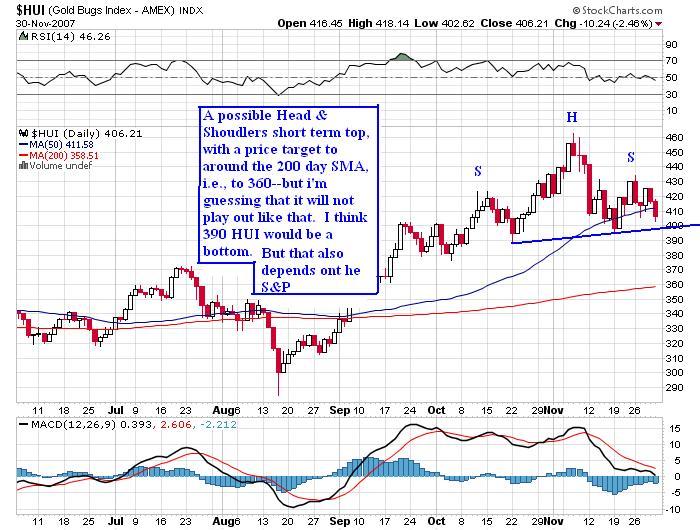
Comments: Sorry for the long pause. I've had a lot on my mind lately so it was difficult to post for a while. Anyway, coming back to the matter at hand, the HUI looks like it is consolidating nicely since running up big until the beginning of November. The consolidation has sliced almost 12% off the HUI from its early November high of just over 460. It has also lasted for over a week now. I think, at this point, time is on the side of gold investors.
There is a danger however of a Head & Shoulders pattern as indicated in the above chart, which, if activated, would point to a drop to the 200 day SMA at around 360-370 HUI. I think such drop require gold to dropping down to 750 or so and the S&P500 taking another dive. Hmm, the more I think aobut it, the more I think that both are possible. Nevertheless, any such drops should not be feared, as I think Gold would have a great chance to bounce back.
Some things I've been paying attention to recently:
1. The COTs are still somewhat bearish, but they have shown some improvement during the last 2 weeks. Still, this situation may need 2 to 3 more weeks, at least, to get to a "bottom" range.
2. Gold:XAU ratio continues to be fairly positive, being closer to a buy than a sell, for gold stocks, staying above 4.50, and even getting as high as 4.90 recently.
3. I'm watchinhg closely what Treasury Secretary Henry Paulson will cook up to stave off the tide of foreclosures. Apparently, the plan will be to freeze teaser rates on certain troubled subprime mortgages. The big question is who will take the hit? The administration has sworn that taxpayer money will not be used in any "bailout". According to the linked article, it may be the investors in the mortgage backed securities who may take the loss, in the form of lower interest rates. I wonder who those investors are and whether they will sue. Anyway, the idea is that lower interest payments will stave off foreclosure which is in nobody's interest. But, such a bailout, if successful, may create some moral hazard. Government to the rescue whenever people screw up. My friend, Andy, put it best that capitalism and free markets take a hit if things are not allowed to fail.
Oh, if you have a chance, check out Jim Sinclair's Mineset. Jim, a die hard gold bug, has predicted 29 of the last 3 financial crises that the U.S. has had, and he has some interesting thoughts about the proposed bailout.
4. Oil has sold off recently, by nearly 10%. But with a cold winter on the horizon and a new set of Iran sanctions getting close to final approval, I wonder if we'll yet see $100 oil on this upleg after all.
5. Turmoil in Venezuela (don't take the "oil" out of "turmoil"...). Talk of nationalization of foreign companies and huge protests over a referendum about a constitutional amendment. I wonder how that will all end up.
6. U.S. market was up this past week after Citigroup got $7.5bil financing from the Abu Dhabi sovereign fund. I guess they needed it, but with an interest rate of 11%--just imagine, a huge commercial bank like Citi borrowing at 11%!--they must be getting desperate.
7. Finally... this is funny. The US Dollar may displace the Yen as the favorite currency for carry trades.
Monday, August 27, 2007
Charts of the Year?
The below two charts could be the charts of the year.
1. the 3 Month Treasury Yield and
2. the Shanghai Composite Index.
Comments: No comments. The chart says it all.
1. the 3 Month Treasury Yield and
2. the Shanghai Composite Index.
Comments: Can you say "Parabolic..."?
Friday, August 24, 2007
HUI back at Resistance
Comments: USDX sliced through its 20 and 50 day SMAs recently. Again, 80.00 to 80.50 is MAJOR support.
Tuesday, August 21, 2007
Bloodbath in Gold Miners
Actually, the current complete dumping of gold stocks (don't even get me started on silver), seems quite irrational considering the actions of the U.S. Fed recently. The Fed has added $100 billion in liquidity in recent weeks, through repo transactions, among others, as well lowering the interbank lending rate by 0.5%. In fact, it added $3.75 billion even today.
And the political pressure is mounting on the Fed. Treasury Secretary Paulson, mentioned today "We're really focused on the subprime market, and we're really focused on the homeowners -- mortgage holders -- who are in danger of losing their homes."
The ever glib Bush, insisted that "The fundamental question, 'Is there enough liquidity in our system?' And the answer is `Yes, there is,'" the president declared. Don't worry Mr. Bush, I have a hunch that when it comes to liquidity, there will soon be more than enough...
Saturday, August 04, 2007
USD - Get Ready to Stick a Fork in It
The USDX looks wonderful for Gold investors. As in wonderfully crappy. The USDX couldn't even make it past the first lateral resistance point at just over 81. Sure, it is still a bit oversold, trading somewhat below its 50 day SMA, but that chart looks very weak right now (i.e., very promising from the perspective of Gold investors). 80.00 to 80.50 is MAJOR support for the USDX, the significance of which cannot be overstated!
With the U.S. churning out horrible economic reports on an almost daily basis, I wonder if this coming week's FOMC rate announcement may result in investors finally sticking a fork in the USDX for good.
But then, who knows, the Gold consolidation has now lasted almost 1.5 years, so it could last a little bit longer yet. It's been so frustrating...
Friday, June 15, 2007
Gold to XAU Ratio
Comments: XAU approaching resistance.

Comments: This chart bears watching. It's very close to a (bullish) breakdown in favor of Gold miners. It's hard to judge right now whether such breakdown would be for real because the general market was up big this past week, taking everything, including gold miners with it. But the RSI has shown a major breakdown (bullish for Gold). I've been reducing my positions into the strength this past week, but I'll be keeping an eye on this ratio.
Thursday, May 31, 2007
Turning Point?
I hate to say it because there have been so many disappointments and false hopes along the way, but today is the first day that miners are positively diverging from Gold in a very significant way. Silver is back out of the danger zone and the HUI should be above its broken trendline, at least as of midday, though that is something I will have to double check. The end of day action will really be the key here. Let's keep our fingers crossed.
HUI absolutely needs to get past 334-335, otherwise it could be a triple top on the 10 day chart.
GDP revision down to 0.6% growth (barely positive growth) is what seems to be feeding this move now along with some other pretty hairy economic numbers recently. Also, sentiment recently was just getting extremely bearish, probably too bearish.
A $1 million value bathtub made from 18 karat gold was stolen from a posh Tokyo hotel yesterday.
HUI absolutely needs to get past 334-335, otherwise it could be a triple top on the 10 day chart.
GDP revision down to 0.6% growth (barely positive growth) is what seems to be feeding this move now along with some other pretty hairy economic numbers recently. Also, sentiment recently was just getting extremely bearish, probably too bearish.
A $1 million value bathtub made from 18 karat gold was stolen from a posh Tokyo hotel yesterday.
Wednesday, May 30, 2007
Metals Market Wrap-Up
1. What the hell is going on with gold stocks? Yesterday gold was up big and the HUI finished in the red. Today, Gold is barely holding on to the lows of the recent move, and gold stocks look like they are positively diverging. C'mon!
2. Jimmy Rogers has turned bearish on Gold for the intermediate term, citing too high COT open interest and general excessive speculation. Jimmy has always argued that there is more money to be made in other commodities, and recently, in particular, the agricultural commodities. But nevertheless, he's an important voice on commodities in general, including Gold.
3. It's not easy to argue that NEM is still the bellwether for the industry, since it is no longer the largest cap stock and since now ABX is a lot less hedged, but, for whatever it is worth, NEM looks like it has been positively diverging in the last few days.
4. Looks like the Chinese regulators are taking the right approach: trying to prick the stock bubble before it gets completely out of hand. I think that is the right move and it will ensure that there is no real "crash". Still, a correction of 20 to 25% is definitely possible. Unlike some analysts who believe now that the Chinese market is the be all and end all, the critical linchpin that, when gone, will cause massive sell offs in other markets, including world stock and commodities markets, I think the Chinese market is just one big irrelevant red herring.
2. Jimmy Rogers has turned bearish on Gold for the intermediate term, citing too high COT open interest and general excessive speculation. Jimmy has always argued that there is more money to be made in other commodities, and recently, in particular, the agricultural commodities. But nevertheless, he's an important voice on commodities in general, including Gold.
3. It's not easy to argue that NEM is still the bellwether for the industry, since it is no longer the largest cap stock and since now ABX is a lot less hedged, but, for whatever it is worth, NEM looks like it has been positively diverging in the last few days.
4. Looks like the Chinese regulators are taking the right approach: trying to prick the stock bubble before it gets completely out of hand. I think that is the right move and it will ensure that there is no real "crash". Still, a correction of 20 to 25% is definitely possible. Unlike some analysts who believe now that the Chinese market is the be all and end all, the critical linchpin that, when gone, will cause massive sell offs in other markets, including world stock and commodities markets, I think the Chinese market is just one big irrelevant red herring.
- (i). The Chinese market had nothing to do with anything until about 1 year ago. The current bull market in commodities and in other stock markets owed nothing to Chinese stock market, which was a phenomenon that arose barely in the last year. How did the Chinese market suddenly become so important for everything?
- (ii). The Chinese market still has significant restrictions on foreign ownership. Sure, some foreigners are able to override that, but it's nothing like Tokyo or NYSE. Foreigners haven't penetrated that market enough for it to have any real collateral significance.
The Chinese market is one big red herring. I'm surprised that so many people believe it's now a linchpin for world markets and the world economy as a whole. It's right up there with the "unwinding of the yen carry trade" scare for the dumbest popular ideas floating around the markets these days.
Tuesday, May 29, 2007
Gold: The Bear Case...
If I were to try to make the bear case for precious metals, I'd have to point to these two charts as presenting the strongest arguments.

Comments: A bullish wedge with the RSI not confirming the recent downward price action. It looks like it is setting up to rally to the $86 to $88 area--if it can break out of the wedge. There is resistance between $82.5 and $84.

Comments: Silver looks VERY weak right now. MACD looks like it wants to roll over.
Coming to think of it, the HUI chart isn't looking all that swell right now either.
Comments: A bullish wedge with the RSI not confirming the recent downward price action. It looks like it is setting up to rally to the $86 to $88 area--if it can break out of the wedge. There is resistance between $82.5 and $84.
Comments: Silver looks VERY weak right now. MACD looks like it wants to roll over.
Coming to think of it, the HUI chart isn't looking all that swell right now either.
Thursday, May 24, 2007
Gold Stock Valuations
I highly recommend the latest article by Adam Hamilton about Gold Stock Valuations.
It's been not much of a secret that gold mining companies have struggled to meet earnings estimates this quarter. In fact, I'm hard pressed to think of any XAU or HUI components which met let alone exceeded estimates.
This was something that really bothered me. But after reading Adam Hamilton's article, I have come to realize that this is really a non-issue.
Hamilton, arguably the most cerebral of the gold analysts, sets for the following arguments:
1. Gold mining stock P/Es have been falling drastically since the start of the gold bull market.
2. Today, gold mining stocks are the cheapest relative to earnings that they have ever been during the current bull market.
3. While the gold mining sector initially needed contrarians to buy into the sector at the gold bottoms around 2001, when P/E ratios were sky high, Hamilton makes the fascinating argument that the succeeding bull market waves in gold miners will ultimately come from mainstream value investors who will realize that gold stocks are finally competitive in value to main stream growth and technology stocks.
The argument is, as is typical of Hamilton, very strongly supported with historic evidence and facts.
I've been worried a lot about how miners have struggled to make money. But after reading that article, it was pretty easy to come to the conclusion that, for the most part, the failures to meet earnings estimates are a non-issue in the gold mining sector, considering the long term trend of falling P/E ratios.
It's been not much of a secret that gold mining companies have struggled to meet earnings estimates this quarter. In fact, I'm hard pressed to think of any XAU or HUI components which met let alone exceeded estimates.
This was something that really bothered me. But after reading Adam Hamilton's article, I have come to realize that this is really a non-issue.
Hamilton, arguably the most cerebral of the gold analysts, sets for the following arguments:
1. Gold mining stock P/Es have been falling drastically since the start of the gold bull market.
2. Today, gold mining stocks are the cheapest relative to earnings that they have ever been during the current bull market.
3. While the gold mining sector initially needed contrarians to buy into the sector at the gold bottoms around 2001, when P/E ratios were sky high, Hamilton makes the fascinating argument that the succeeding bull market waves in gold miners will ultimately come from mainstream value investors who will realize that gold stocks are finally competitive in value to main stream growth and technology stocks.
The argument is, as is typical of Hamilton, very strongly supported with historic evidence and facts.
I've been worried a lot about how miners have struggled to make money. But after reading that article, it was pretty easy to come to the conclusion that, for the most part, the failures to meet earnings estimates are a non-issue in the gold mining sector, considering the long term trend of falling P/E ratios.
Metals Sector Wrap Up
1. AP reported that sales of new homes surged in April by the biggest amount in 14 years, but the median price of a new home dropped by the largest amount on record. Now if that was graphed on a candlestick graph with volume overlay, it would look like a big and long red candle on heavy volume. Ouch!
2. Novagold Resources (NG) announced yesterday a partnership with Tech Cominco (TCK) to build its $2 billion Galore Creek copper-gold mine in northwestern British Columbia. Although shares of NG surged up to 11% yesterday, they are still well off the highs during the period of the Barrick bid. Under the terms of the partnership, NG will cede 50% control of the project to Tech Cominco. I wonder if some NG investors have had second thoughts about rejecting the tie up with Barrick.
3. The surge in the price of uranium during the last months seems to have prompted some gold mining companies such as Harmony Gold Mining to consider ramping up uranium investments. Harmony is considering spinning of its uranium assets into a separate company.
4. Speaking of Harmony, it joined the list of recently miners to close out their gold hedge books when it announced last week it closed out its Australian hedge book for $75 million.
5. CUP has been on fire lately despite copper weakness. HL at trendline support right now.
2. Novagold Resources (NG) announced yesterday a partnership with Tech Cominco (TCK) to build its $2 billion Galore Creek copper-gold mine in northwestern British Columbia. Although shares of NG surged up to 11% yesterday, they are still well off the highs during the period of the Barrick bid. Under the terms of the partnership, NG will cede 50% control of the project to Tech Cominco. I wonder if some NG investors have had second thoughts about rejecting the tie up with Barrick.
3. The surge in the price of uranium during the last months seems to have prompted some gold mining companies such as Harmony Gold Mining to consider ramping up uranium investments. Harmony is considering spinning of its uranium assets into a separate company.
4. Speaking of Harmony, it joined the list of recently miners to close out their gold hedge books when it announced last week it closed out its Australian hedge book for $75 million.
5. CUP has been on fire lately despite copper weakness. HL at trendline support right now.
Subscribe to:
Comments (Atom)