A federal grand jury returned the following indictments on April 24 with respect to E-Gold and its owner: each with one count of conspiracy to launder monetary instruments, one count of conspiracy to operate an unlicensed money transmitting business, one count of operating an unlicensed money transmitting business under federal law and one count of money transmission without a license under D.C. law. Subsequent to the indictment, the Department of Justice also obtained a restraining order on the defendants to prevent the dissipation of assets by the defendants, and 24 seizure warrants on over 58 accounts believed to be property involved in money laundering and operation of an unlicensed money transmitting business.
The indictment alleges that E‑Gold has been a highly favored method of payment by operators of investment scams, credit card and identity fraud, and sellers of online child pornography. The indictment alleges that the defendants conducted funds transfers on behalf of their customers, knowing that the funds involved were the proceeds of unlawful activity; namely child exploitation, credit card fraud, and wire (investment) fraud; and thereby violated federal money laundering statutes.
According to this, it appears that gold is passing the ultimate litmus test for validity as a currency: acceptance by organized crime. An anecdotal factor that is definitely gold bullish.
Monday, April 30, 2007


Saturday, April 28, 2007
Charts of Interest
Some interesting charts.
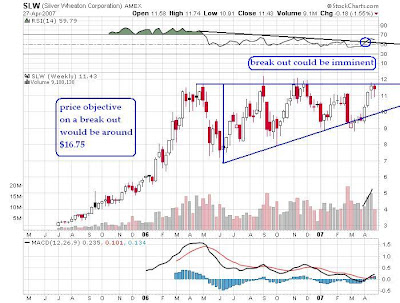
Comments: SLW looks like it's getting ready to break out. SLW recently announced the acquisition of two new silver streams, including all of the silver produced from the Stratoni mine in northern Greece operated by Hellas Gold S.A. a majority owned subsidiary of European Goldfields for $57.5 million and, more importantly, 25% of the life of mine silver production from Goldcorp’s Peñasquito Project, located in Zacatecas, Mexico, for $485 million.
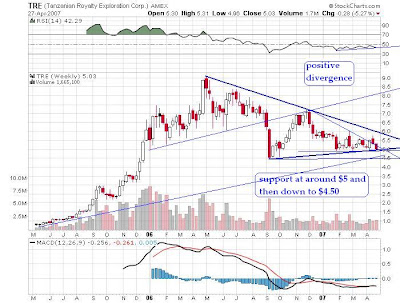
Comments: This company continues to issue press releases that are little more than fluff, at an alarming rate. Nevertheless, it is at around support at $5. Further support appears at around $4.50. Jim Sinclair wants a partnership with the Chinese regarding the Kigosi nickel exploration project. But the recent terrorist strike on a Chinese oil exploration base in nearby Ethiopia, which resulted in the killing of 65 Ethiopians, 9 Chinese and the kidnapping of 7 other Chinese, is hardly wonderful PR for Chinese resource projects in the Horn of Africa. Needless, to say, the attack didn't get any airtime whatsoever on JS's Mineset.com since JS's Mineset.com policy seems to be not to comment whatsoever on what is happening in the Horn of Africa region.
 Comments: I predicted in late February, that the price target for GSS's breakout would be $4.90. I was only 5 cents off as GSS skied to $4.95 before selling off. After GSS's great run up, it appears that GSS is trying to find a bottom on its consolidation. I think around $4.25 and just below $4.00 are two areas where GSS could see support, assuming that Gold continues to sell off.

Comments: SLW looks like it's getting ready to break out. SLW recently announced the acquisition of two new silver streams, including all of the silver produced from the Stratoni mine in northern Greece operated by Hellas Gold S.A. a majority owned subsidiary of European Goldfields for $57.5 million and, more importantly, 25% of the life of mine silver production from Goldcorp’s Peñasquito Project, located in Zacatecas, Mexico, for $485 million.

Comments: This company continues to issue press releases that are little more than fluff, at an alarming rate. Nevertheless, it is at around support at $5. Further support appears at around $4.50. Jim Sinclair wants a partnership with the Chinese regarding the Kigosi nickel exploration project. But the recent terrorist strike on a Chinese oil exploration base in nearby Ethiopia, which resulted in the killing of 65 Ethiopians, 9 Chinese and the kidnapping of 7 other Chinese, is hardly wonderful PR for Chinese resource projects in the Horn of Africa. Needless, to say, the attack didn't get any airtime whatsoever on JS's Mineset.com since JS's Mineset.com policy seems to be not to comment whatsoever on what is happening in the Horn of Africa region.
 Comments: I predicted in late February, that the price target for GSS's breakout would be $4.90. I was only 5 cents off as GSS skied to $4.95 before selling off. After GSS's great run up, it appears that GSS is trying to find a bottom on its consolidation. I think around $4.25 and just below $4.00 are two areas where GSS could see support, assuming that Gold continues to sell off.
Tom recently gave the following, fairly exciting, update about GSS.
"Between now and May 10th I expect to see the following news released in either PR's or on the Q1 CC:
1) Commissioning of Biox.
2) A full month of Biox recovery rates and production numbers from Module #1.
3) The feasibility study from Hwini-Butre / Benso.
4) BoD approval of the above mentioned project. This is extremely important to the Wassa mill, as the blending of the new ore with the existing feedstock will increase production from 110,000 ounces to 200,000 per annum.
5) Possibly an increase in reserves as a result of the drilling programs there. If they do include the reserves, it should be very substantial."
1) Commissioning of Biox.
2) A full month of Biox recovery rates and production numbers from Module #1.
3) The feasibility study from Hwini-Butre / Benso.
4) BoD approval of the above mentioned project. This is extremely important to the Wassa mill, as the blending of the new ore with the existing feedstock will increase production from 110,000 ounces to 200,000 per annum.
5) Possibly an increase in reserves as a result of the drilling programs there. If they do include the reserves, it should be very substantial."
Tom also provides the following update regarding the energy crisis in Ghana:
"The power problem is still there, but it is improving IMO. I monitor 14 sites in Ghana and Burkina Faso that feed the Akosombo Reservoir. The drought is over and the rains are increasing. Every week a handfull of the areas have between 1" and 5" of rain. In the meantime, the government is installing emergency generating units as fast as they can. The bottom line as I see it, is that for the remainder of Q2 GSS will be operating at a 75% power allocation, plus whatever they choose to produce themselves from their own diesel units. These units can potentially supply them with 30% of their total power, but are extremely expensive and difficult to keep running. Q2 should be profitable, but only by $.03-.04 as best I can tell at this point."
Tom predicted the imminent breakout of GSS in early November, commenting at that time on a press release ""Game winning home run in the bottom of the 9th!" At first, GSS didn't do anything particularly interesting, but within a few weeks after Tom's comments, GSS started to skyrocket on its way to a 66% gain.
In light of the foregoing, I think it would be a good idea to buy up GSS on this pullback. I already made a couple of buys.
Comments: AEM is close to support. A breakout of the slightly declining (bullish) wedge would lead to a rally of about +$8.
Trading Yamana Gold (AUY)
 Comments: AUY has periods of in line performance with the HUI, followed by periods during which AUY strongly outperforms the HUI. I believe that AUY recently completed a period of outperformance of the HUI, as you can see in the chart above. Accordingly, even if the HUI rockets up, I think AUY will only follow in-line with the HUI, at least for a while. The period of in-line performance seems to last about 6 to 8 months.
Saturday, April 21, 2007
Royalty Companies set to Underperform?
The COT numbers showed the all time second biggest net short gold position by commercial traders, which should be bearish in the short term.

If there is any pull back or consolidation, and I think there is a pretty decent chance of one occurring, two companies to be wary of are RGLD and TRE, both of which employ a royalty model.
Neither company really participated in the recent gold and HUI rally. The only caveat to that comment is that these two companies tend to be less correlated (for some reason) than the average gold mining company to the Gold indices, so it's possible that they may hang tough on any pullback. Still, I wouldn't bet on it.

Comments: TRE went nowhere fast during the recent upswing. With no significant royalty payments on the horizon and with press releases that would be best described as "fluff", it's probably not a big surprise.
 Comments: RGLD, a fully developed company whose royalty revenues TRE could only wish for, also did not respond very positively during the recent gold rally. The surprising thing was that there was little bounce back after the recent share offering was completed. RGLD has solid royalty revenues from various properties, but with a P/E ratio of 44.7, it may be vulnerable.
Thursday, April 19, 2007
Update: Compania de Minas Buenaventura SA (BVN)
 Comments: BVN has broken out of a 1.5 year trading range on nice accumulation. I'd be a buyer on any pullback, such as the one that we are getting right now. BVN is an equity partner at the Yanacocha mine in Peru and operates 4 other smaller mines as well. Yanacocha, operated by Newmont, is one of the two biggest gold mines in the world. The main complaint against BVN has generally been that it has been a partial gold hedger. However, on March 9, BVN announced that it had bought back 25% of its hedge book, which apparently helped to spark the current rally.
Wednesday, April 18, 2007
Update on Kimber Resources (KBX)

Comments: After failing to get back up above resistance, looks like Kimber is falling away and will likely retest at least recent lows, especially if the gold price turns south for a change. The company recently announced, among other things, that Darren Klinck, Kimber's Vice President of Corporate and Investor Relations, who put up an excellent IR front on behalf of the company, will be departing the company. Despite my anger with the company because of their shenanigans, I really wish Darren all the best. He took his job very seriously and, in my opinion, he did a great job. He timely responded at length to all of my questions about Kimber. Too bad the company has performed so poorly.
Thursday, April 05, 2007
HUI Approaches Sell Zone
 Comments: I sold down as the HUI has been up four days in a row and is now approaching significant lines of resistance along the channel line and lateral resistance. I expect the area HUI 358 to 362 to provide significant resistance for reasons that should be obvious when looking at the chart above. The surprising thing is that Gold and the HUI isn't down more after the news of the release of the British serviceman by Iran. That potentially bodes well going forward as I was sure that Gold would come at least temporarily under pressure following the revelation that they aren't going to get the Abu Ghraib treatment in Tehran. GSS and CUP did best for me during the recent run, TRE did the worst.
Monday, April 02, 2007
The Spin Starts Here
I guess you sometimes have to excuse Jim Sinclair for some of his more over the top comments at his website www.jsmineset.com . After all, Jim is a gold fan and enthusiast.
When you see statements like "the man in charge in Iran now was the man in charge of taking US hostages in the Carter Administration" you just have to grin and bear it, even though you know that nothing has ever been found to support the statement and believe me, if there was the slightest piece of evidence to support it, the current U.S. government would have jumped at it, not to mention the fact that the current President of Iran appears to look younger than the hostage taker in the pictures that have been circulated in media reports, which seems a bit inexplicable, considering that 27 years have passed since the incident.
And then, there are grave warnings on Jim's site about the recent protectionist measures imposed against China, with grim references to the protectionist Hawlet-Smoot Tariff Act of 1930, while a free trade agreement with South Korea that is the largest of its kind since NAFTA is dismissed by Jim as irrelevant.
That's all fine, since, like I said, Jim is an enthusiast so a little bit of spin is expected (even though his website purportedly claims that "The Spin really does stop here."
However, when it comes to company related information, that is an area where the Spin really does need to stop and, judging by Tanzanian Royalty Exploration Corporation's (TRE) news release last Friday, unfortunately it didn't. Apparently, the British Columbia Securities Commission caught on that TRE had made several misstatements as a result of which investors may have been misinformed causing TRE to make a news release (tactfully titled "News Release") to correct certain misperceptions that may have arisen as a result of previous releases, repeatedly pointing out that certain pieces of information released by the company relating to mineral deposits were not compliant with Canadian regulations and therefor "should not be relied upon".
Also, I personally wasn't all that impressed with TRE's previous news release about the startup of work on its purported nickel bearing properties. The first three paragraphs of the release seem primarily to tout the nickel project in the Kabanga region which is being conducted by Xstrata and Barrick and have little to do with TRE.
When it comes to opinions about Gold, a bit of over the top spin is fine from time to time, but when it comes to company news releases, the Spin really does need to stop there.
When you see statements like "the man in charge in Iran now was the man in charge of taking US hostages in the Carter Administration" you just have to grin and bear it, even though you know that nothing has ever been found to support the statement and believe me, if there was the slightest piece of evidence to support it, the current U.S. government would have jumped at it, not to mention the fact that the current President of Iran appears to look younger than the hostage taker in the pictures that have been circulated in media reports, which seems a bit inexplicable, considering that 27 years have passed since the incident.
And then, there are grave warnings on Jim's site about the recent protectionist measures imposed against China, with grim references to the protectionist Hawlet-Smoot Tariff Act of 1930, while a free trade agreement with South Korea that is the largest of its kind since NAFTA is dismissed by Jim as irrelevant.
That's all fine, since, like I said, Jim is an enthusiast so a little bit of spin is expected (even though his website purportedly claims that "The Spin really does stop here."
However, when it comes to company related information, that is an area where the Spin really does need to stop and, judging by Tanzanian Royalty Exploration Corporation's (TRE) news release last Friday, unfortunately it didn't. Apparently, the British Columbia Securities Commission caught on that TRE had made several misstatements as a result of which investors may have been misinformed causing TRE to make a news release (tactfully titled "News Release") to correct certain misperceptions that may have arisen as a result of previous releases, repeatedly pointing out that certain pieces of information released by the company relating to mineral deposits were not compliant with Canadian regulations and therefor "should not be relied upon".
Also, I personally wasn't all that impressed with TRE's previous news release about the startup of work on its purported nickel bearing properties. The first three paragraphs of the release seem primarily to tout the nickel project in the Kabanga region which is being conducted by Xstrata and Barrick and have little to do with TRE.
When it comes to opinions about Gold, a bit of over the top spin is fine from time to time, but when it comes to company news releases, the Spin really does need to stop there.
Monday, March 26, 2007
Gold Chart
 Comments: I just returned from an unexpected business trip to Nigeria, hence the lack of updates recently. The above chart shows that Gold has been creating a channel with some obvious buy and sell points. The HUI seems overbought in the short term, but it is now consolidating for a couple of days. My exposure remains 31% and I think I sold a bit too early. Hopefully I'll be able to get back on board with at somewhat lower prices, though it's unclear where we are going next in Gold. The COT report remains bearish in my opinion.
On a side note, an interesting article about a company (Nautilus Minerals Inc.) listed on the Vancouver exchange that will be trying to prospect for metals below the ocean.
Tuesday, March 13, 2007
Gold to XAU Ratio
 Comments: The Gold to XAU ratio is at it again, testing 5.00. Usually values at around 5.00 have resulted in relative buying of the mining shares, but I have a bad feeling about it this time. As I mentioned before, it is possible that the Gold/XAU ratio may have had a "bullish" breakout with a price target of 5.8 to 6.00, which would be very bad for the mining shares--though eventually it would mean a great buying opportunity. All this suggests that GLD and SLV may be better than the miners for now. Let's keep in mind that during the year and a half period of consolidation in 2004 and 2005, the Gold/XAU was well north of 5.00 for 6 weeks. That is quite possible again here because, obviously, we are again currently in a period of major consolidation.
Among the miners, I'm currently looking at CUP (copper not gold, but that's the whole point) and UXG. UXG has been poor but I think that is partly because of the bad experience investors had after their previous merger attempt with their Nevada neighbors collapsed. If they can pull of the merger this time, UXG could potentially enjoy a nice markup, but it is a speculative play. The offer expires March 23, so pretty soon. I also like it because it's correlation to the HUI is relatively low.
My buddy Dean recently sent me an article from the left-leaning NY Times titled "China to Open Fund to Invest Currency Reserves". According to the article, "China will create an agency to invest its immense reserves of foreign currency, now totaling more than $1 trillion, the country’s finance minister announced on Friday."
"They’re not going to be looking for financial assets, but energy assets and natural resources, minerals, things China desperately needs,” said Jing Ulrich, an analyst at JPMorgan.
Although no mention is made of Gold, the mere act of diversifying away from US Dollar-denominated reserves could potentially have positive spill-over effects on Gold.
Tuesday, March 06, 2007
Following the Commercials
 Comments: Last week's Commitment of Traders report showed the largest net short interest in Gold contracts during the last year, which definitely helps explain the action of the last week during which gold gave up around $45. Major tops in Gold have frequently been marked by peaks in the net short interest of commercial traders.
Unfortunately, it typically takes about 8 weeks for this kind of situation to reverse itself so I'm not expecting any huge comeback rallies anytyime soon, though a bounce here seems quite plausible. Hopefully this week's report will show commercial net short interest falling precipitously again.
The COT report is not perfect as a timing device and commercials are not always right. For instance in April to May of 2006, it seemed that the trade went against them as Gold soared higher while net short interest stayed about constant. More often than not, however, commercials have been in control and it has paid to follow them.
Friday, March 02, 2007
Gold to XAU Ratio
 Comments: The Gold to XAU ratio flashed an ominous sign on Tuesday by appearing to break out of a long symmetric triangle consolidation. If that is the case, the "price" objective for the ratio would be around 5.7 to 5.8, which would mean continued massive underperformance of the mining shares to Gold for at least several months.
However, it's unclear that it's going to necessarily go that way just yet. The USD has done basically nothing during the last few days and Oil is still well over $60 per barrel so the current action in Gold is a bit strange. However if the Gold to XAU ratio continues to climb above 5.00, the writing will be on the wall for the miners even if Gold maintains itself above $600--which I think would be quite likely.

Comments: Upon a further measurement, it appears that the price target would be 6.00 not 5.80. That is suspiciously close to a potential channel line.
Sunday, February 25, 2007
Accumulate GSS on Pullbacks

Looking for a Gold stock that is really on a roll? Look no further than Golden Star Resources. After frustrating investors for so long during a long period when everything seemed to just go wrong for GSS, it looks like GSS management is finally putting the pieces together.
Even after getting slammed down after the announcement of a secondary offering earlier last week, GSS just roared right back and is trading right around the same price as it had when the offering was first announced 3 days ago. Hard to imagine more bullish action than that. I believe that the current price level (i.e., around $3.90) should be short term resistance, but I would be a buyer on any dip here. My price target for GSS is about $4.90 for the current move.
Here is Tom's latest about the upcoming schedule and prospects for GSS:
"GSS has a steady stream of news and events scheduled between now and June. They aren't planning on giving the manipulators time to put on a raid again. Every one to two weeks something positive is planned to happen:
- Biox #1 commissioned
- Successful offering
- Q4 earnings CC
- St. Jude feasibility study and BOD approval
- Biox #2 commissioned
- Biox in service
- Q1 earnings CC and
- first Biox production numbers
- Power plant in service
Add in a couple more PRs covering exploration, JVs, upgrades, or whatever, and it averages 1 every 10 days.
At this point my only regret is not taking advantage of the pullback to add to my positions. Afraid I was waiting for a lower price like everyone else.
As far as I can tell, the long awaited upmove has already begun, and is rapidly gathering speed and momentum. By Q3 we should have proof that Biox works. If the production and recovery rate meets expectations, Golden Star's stock price may surpass AUY in a year or so."
Very few investors put in as much time and effort into researching a company as much as Tom does and he's been really on the ball about GSS a number of times now.
Tom also subsequently adds the following notes of caution to balance out his positive comments which I posted above:
* We are talking about Ghana...a third world country. They are a democracy, and are making great strides in developing the country and bringing it into the 21st century. Although they are making progress, much work remains to be done.
* I am not an expert on arbitrage. I would think that the arbs would have shorted the stock and planned to buy shares to cover out of the new issuance for a quick profit. For all I know, this may still happen over the next 3 days. It is also possible that some selling may occur after the issuance due to profit taking...I just don't know.
* The size of the offering surprised me, as I saw no need for that much additional cash with Biox on the verge of adding a flood of cash to their coffers. My gut tells me they want to expedite development of a number of projects to add to production and lower costs, but I don't know that for a fact.
Friday, February 23, 2007
HUI 400
 Comments: I'm guessing the initial target for this move will be HUI 400 or so. That would mean a double top in the HUI. Hopefully it won't stop there however. Still, the gold miners for the most part are not maintaining that much leverage during this move, which makes me wonder whether this move will be all that great. The Gold chart suggests that the measured move will be to about $750 however. Maybe it will be better to be in SLV or CEF than in miners. Or maybe a mix of SLV/CEF and miners.
Comments: Although we've been in a uptrend recently, the XAU to Gold ratio has not yet tipped its hand. In fact, the leverage, with the exception of the occasional upburst, has not been that great so far into this move. Once the formation is broken, it will be a very big move in one direction or the other. About 1.00 up or down. So up to 5.7 or down to 3.4.
From the low in January to the close in Friday, the percentage gains for precious metals investments have been:
SLV: 18.66%
HUI: 16.75%
GDX: 15.58%
CEF: 14.68%
GLD: 13.50%
XAU: 13.00%
The fact that the XAU is the worst performer of the 6, i.e., that Gold and Silver stocks as measured by the main index have underperformed Gold and Silver, definitely raises some issues about the destiny of this move.
Thursday, February 22, 2007
Inflation Confusion
1. It appears that we're back in the land of inflation confusion. Yesterday's surprising CPI print which showed higher than exected inflation both in the headline and core level, led to a surprising result. Gold was up AND the U.S. dollar was up. Chuck Butler, the President of Everbank World Markets, had the following comment today on this continuing confusion about inflation and what it really entails:
2. It appears the insurgents in Iraq are using new tactics, blowing up a couple of tankers filled with Chlorine gas recently in so called "dirty" chemical attacks. Meanwhile, another helicopter was brought down by small arms fire. "Army Lt. Gen. Ray Odierno said the military has noted similarities in some of the eight helicopter incidents in the past month in which aircraft were either shot down or landed under fire. A few of them might have been ambushed, he said." 8 choppers have been downed recently.
3. Another surprise was the Yen trading at 10 year lows against some currencies following the BOJ's 0.25% interest rate hike to 0.5%. Not many things are going the way one would think they should. Though, frankly, I'm not that surprised that the Yen has been weak. In fact, I fully expect it to be weaker if the BOJ continues to manage it the way it has. The Yen is basically a third world currency with plenty of inflation in the pipeline already. They're a "mere" 19 rate hikes behind the U.S., and the U.S.'s 5.25% isn't exactly ultra restrictive in any case.
4. A ">$2 million coin anyone?
5. NEM and ABX announced earnings today. Looks like cash costs are rising all around.
6. Keep your eyes on this stock: Gold Resource Corporation.
"Yes, this goes back to the Pfennig I wrote a couple of weeks ago about how things have changed over the years, and that low inflation doesn't warrant a strong currency any longer... The markets crave high interest rates... And you don't get high interest rates without inflation! This thought process is demented... Unfortunately, that's the thought process in the markets these days, so we have to play the game."
2. It appears the insurgents in Iraq are using new tactics, blowing up a couple of tankers filled with Chlorine gas recently in so called "dirty" chemical attacks. Meanwhile, another helicopter was brought down by small arms fire. "Army Lt. Gen. Ray Odierno said the military has noted similarities in some of the eight helicopter incidents in the past month in which aircraft were either shot down or landed under fire. A few of them might have been ambushed, he said." 8 choppers have been downed recently.
3. Another surprise was the Yen trading at 10 year lows against some currencies following the BOJ's 0.25% interest rate hike to 0.5%. Not many things are going the way one would think they should. Though, frankly, I'm not that surprised that the Yen has been weak. In fact, I fully expect it to be weaker if the BOJ continues to manage it the way it has. The Yen is basically a third world currency with plenty of inflation in the pipeline already. They're a "mere" 19 rate hikes behind the U.S., and the U.S.'s 5.25% isn't exactly ultra restrictive in any case.
4. A ">$2 million coin anyone?
5. NEM and ABX announced earnings today. Looks like cash costs are rising all around.
6. Keep your eyes on this stock: Gold Resource Corporation.
Tuesday, February 20, 2007
HUI Retreats from Resistance
 1. Looks like the HUI is retreating from resistance. That makes sense to me. As I mentioned, the fundamentals are not optimal at the moment for a great Gold advance and the mining shares have been underperforming Gold, which is often not a good sign. Sentiment has been getting pretty bullish recently as well, perhaps too bullish. 340 is first support on the HUI, but if it can't hold that, then I think we will see a more pronounced correction, with Gold retreating back to $640 or so. That might provide a good buying opportunity. I'll be watching the Gold/XAU ratio closely as well. It's at 4.74 at the moment, which is fairly high. Above 5.00 and I believe it's just a question of time before we get a reversal--though ideally, I'd love to buy back in between 5.10 and 5.30. actually, I'm hoping for a nasty sell of now that I've been out of the miners for a few days. Looks like Andy and my patience may have paid off after all.
2. In company specific news, the usually snake-bitten GSS, which was actually one of the few gold miners companies that really shone recently, is getting killed today after announcing a secondary offering. It's down almost 8% today. After the chart repairs the damage, I think GSS should be a good bet. They've been coming out with fairly good news recently and seem to be generally turning things around. I'll have to get Tom's comment on the latest announcement. EGO, another strong performer recently, is also slammed today after announicng that its merger talks with Centerra are over. down 6%.
3. SA and IAG on the other hand, are trading up because of positive announcements. SA announced that a study of its Mitchell gold-copper discovery has confirmed a major new resource which may have significant expansion potential. At the moment, they estimate that Mitchell, which is one of their two main properties (Courageous Lake being the other) has an inferred resource of 13.1 million ounces of gold. SA's CEO, Rudy Fronk states in SA's press release today that "We could not be more encouraged by our prospects for value creation in 2007." Of course every CEO is likely to say that, however, I think SA's optimism may be justified. IAG is up on the announcement over the weekend of a a substantial increase in gold reserves and resources at its Rosebel Gold Mine in Suriname. KBX has also been strong into the general selling.
4. Volume is now coming in fast and furious on GDX during the last 30 minutes of trading and that's not a good sign.
5. Goldcorp (GG) announced the sale of two mines today to raise $300 million in a cash and stock deal. One of the two to go was the underperforming Amapari mine in Brazil. The Amapari mine was a money loser for GG, operating as of September 30 at a cash cost of $538 per ounce. Looks like GG is continuing to raise cash for the development of the Penasquito mine in Mexico. UBS lowered its target price on the news for GG, noting that the consideration for the mines, which also included $100 million in the shares of the acquirer, was below their valuation for the assets. GG is underperforming the HUI today, down 3.23% right now.
6. Lots of company specific news today, however, on the geopolitical front, it's worth noting that the troubles in Somalia are not yet over, with attacks increasing recently. I still think that area may develop into an Iraq-type of situation and it is, after all, adjacent to a major oil shipping route. so this is a development that bears watching.
Friday, February 16, 2007
Gold Shares at an Important Juncture
 1. As is apparent from the chart above, we're at an important juncture for Gold Mining shares. It could go either way, but I think we aren't yet ready to break out of the huge triangle pattern that has been developing since May.
2. The helicopter shootdown theme first identified here at the end of January is getting a lot of attention in the media recently.
3. Looks like the U.S. Mint is taking a step in the right direction with the rollout of the $1 coin. At least it will have some intrinsic value due to the metal content. If you know the exact content and melt value of the new coin, let me know.
3. In company specific news, UXG relaunched its tender offers for White Knight Resources, Nevada Pacific Gold & Tone Resources, each at a 25% premium to the price of each company's shares at a day prior to UXG's previous take over announcement. The offer will expire on March 23.
4. Copper Update: CUP is back in an uptrend. I'd accumulate on any pullback, especially if it pulls back below $4. NTO has also been strong during the recent mini surge in copper prices but it has major resistance at around $4.10. TGB is another copper play. But CUP has the best chart out of the three in my opinion.
Tuesday, February 13, 2007
Divergence of Opinions
An interesting divergence of opinion from two of the more notable Gold analysts. Clive Maud is very strongly bullish at the moment (though his opinion is a bit qualified) and believes that the breakout has already started. In his February 12 piece, provocatively titled "HUI Set to Advance To 700 - 900..." Maud writes that "gold’s next uptrend isn’t a matter of conjecture or about to begin - it has already begun."
Jim Sinclair, on the other hand, has expressed a rare note of caution due to the divergence between the price of Gold and the Gold mining shares, noting also on February 12 that "Gold breaks above a key level, but not gold shares in general. I find that disquieting. There are always exceptions, we both know that. I am speaking of market phases, not of trends. Within a major bullish gold price uptrend there are bear phases. If a short can cover at a profit it is a bear phase within a bull market."
Frankly, that's about as bearish as I have ever heard big Jim. Good to know that he at least still calls it the other way occasionally.
The thing that I will be looking for over the next few days is whether we see some leverage reappearing in the mining shares relative to Gold. That's been a long time coming and without it, I don't see this move going all that much further (though it could potentially go as high as $680). So far, I'm not seeing that. Gold is about as high as it was on Friday, but we're still 4 HUI points below the Friday HUI peak. But we'll see, the day is still young.
2. In the meantime, the trade deficit for 2006 set a new record of $763.6 billion. This was the fifth consecutive annual record, and a 6.5 percent increase from the previous record of $716.7 billion set in 2005.
3. Coming back to Kimber Resources, that snake-bitten company, since Kimber's AMEX IPO occurred fairly recently, it's difficult to determine what would be an appropriate level of support for the current down trend and offer a pretty decent entry point (or reentry point). We have to look to the chart the Kimber shares trading on the Toronto Stock Exchange to see how low it might fall. Looking at that chart, I think a price of about US$1.20 (Canadian $1.40) seems like it should be support eventually. Then the long road back up. [I will have to post the chart of KBX.TO later, as there seems to be a technical difficulty in doing so at the moment.]
4. My friend Sandra forwarded to me a piece from the WSJ about the rising popularity of palladium in jewelry. The article notes that palladium is starting to look attractive not only as a platinum substitute but also as a substitute for white gold (which is gold alloyed with another metal, like nickel), because it is now much less expensive and because it weighs relatively little compared to the dense platinum. Interestingly, the article noted that "about 80% of sales of palladium jewelry come from China". I guess the newly rich over there aren't quite rich enough to afford Gold and Platinum. Interestingly, as far as I am aware, the obsession with using platinum in bridal jewelry is fairly unique to the U.S. In most other countries I have been to, the preferred metal setting for bridal ornaments is gold. If you know of a country other than the U.S. in which a metal other than Gold is preferred for bridal jewelry, let me know.
5. In a development that is bearish for Gold, North Korea agreed to terms in the 6 party talks relating to the nuclear issue. North Korea has been nothing short of a disaster for gold investors in the last year. Empty threats and blather and malfunctioning missiles and now this. [Edit: I was subsequently reminded by my friend Christine that I should probably be looking at the bigger picture as far as this issue is concerned, rather than just from the point of view of an investor. After all, I live in Seoul and I can't make any profit if I am dead. Food for thought...]
Jim Sinclair, on the other hand, has expressed a rare note of caution due to the divergence between the price of Gold and the Gold mining shares, noting also on February 12 that "Gold breaks above a key level, but not gold shares in general. I find that disquieting. There are always exceptions, we both know that. I am speaking of market phases, not of trends. Within a major bullish gold price uptrend there are bear phases. If a short can cover at a profit it is a bear phase within a bull market."
Frankly, that's about as bearish as I have ever heard big Jim. Good to know that he at least still calls it the other way occasionally.
The thing that I will be looking for over the next few days is whether we see some leverage reappearing in the mining shares relative to Gold. That's been a long time coming and without it, I don't see this move going all that much further (though it could potentially go as high as $680). So far, I'm not seeing that. Gold is about as high as it was on Friday, but we're still 4 HUI points below the Friday HUI peak. But we'll see, the day is still young.
2. In the meantime, the trade deficit for 2006 set a new record of $763.6 billion. This was the fifth consecutive annual record, and a 6.5 percent increase from the previous record of $716.7 billion set in 2005.
3. Coming back to Kimber Resources, that snake-bitten company, since Kimber's AMEX IPO occurred fairly recently, it's difficult to determine what would be an appropriate level of support for the current down trend and offer a pretty decent entry point (or reentry point). We have to look to the chart the Kimber shares trading on the Toronto Stock Exchange to see how low it might fall. Looking at that chart, I think a price of about US$1.20 (Canadian $1.40) seems like it should be support eventually. Then the long road back up. [I will have to post the chart of KBX.TO later, as there seems to be a technical difficulty in doing so at the moment.]
4. My friend Sandra forwarded to me a piece from the WSJ about the rising popularity of palladium in jewelry. The article notes that palladium is starting to look attractive not only as a platinum substitute but also as a substitute for white gold (which is gold alloyed with another metal, like nickel), because it is now much less expensive and because it weighs relatively little compared to the dense platinum. Interestingly, the article noted that "about 80% of sales of palladium jewelry come from China". I guess the newly rich over there aren't quite rich enough to afford Gold and Platinum. Interestingly, as far as I am aware, the obsession with using platinum in bridal jewelry is fairly unique to the U.S. In most other countries I have been to, the preferred metal setting for bridal ornaments is gold. If you know of a country other than the U.S. in which a metal other than Gold is preferred for bridal jewelry, let me know.
5. In a development that is bearish for Gold, North Korea agreed to terms in the 6 party talks relating to the nuclear issue. North Korea has been nothing short of a disaster for gold investors in the last year. Empty threats and blather and malfunctioning missiles and now this. [Edit: I was subsequently reminded by my friend Christine that I should probably be looking at the bigger picture as far as this issue is concerned, rather than just from the point of view of an investor. After all, I live in Seoul and I can't make any profit if I am dead. Food for thought...]
Saturday, February 10, 2007
No New Tactics in Helicopter Attacks
In keeping with the helicopter theme, another article has now appeared to weigh in on whether the recent helicopter shoot downs in Iraq constitute a new trend. According to the AP, the U.S. Army's vice chief of staff, reported today that there is no basis for believing that insurgents' recent success in shooting down U.S. helicopters in Iraq means they have developed new attack methods or discovered new U.S. vulnerabilities.
I agree that it's too early to tell whether this is actually a new trend or simply a statistical anomaly. But I think the losses highlight the determination and ability of the enemy that the U.S. forces face in Iraq. After all, the U.S. has the best trained and best equipped armed forces in the world and you have to be exceedingly tough and determined to engage them successfully. Whether or not this is a new trend, the recent losses point to the fact that the U.S. is not fighting a static enemy, but an enemy that is cunning and adaptive.
Looking ahead in time, what would be the effect on Gold if the U.S. would be forced to withdraw from Iraq? It's unclear, but obviously it would depend on the terms on which the U.S. withdrew and what would happen afterwards in Iraq. Obviously, two scenarios that would be fairly Gold bullish in the long term would be if Iraq fell under the sway of militant Islam or if it became a state closely aligned with Iran, allowing Iran to control both sides of the Hommuz Strait, which is a major oil shipping route. In the short term, this might be offset somewhat by the fact that the withdrawal would obviate the immense dollar dilutive expenditures that are required to keep the War going as well as putting a stop to the steady material and personnel losses.
I agree that it's too early to tell whether this is actually a new trend or simply a statistical anomaly. But I think the losses highlight the determination and ability of the enemy that the U.S. forces face in Iraq. After all, the U.S. has the best trained and best equipped armed forces in the world and you have to be exceedingly tough and determined to engage them successfully. Whether or not this is a new trend, the recent losses point to the fact that the U.S. is not fighting a static enemy, but an enemy that is cunning and adaptive.
Looking ahead in time, what would be the effect on Gold if the U.S. would be forced to withdraw from Iraq? It's unclear, but obviously it would depend on the terms on which the U.S. withdrew and what would happen afterwards in Iraq. Obviously, two scenarios that would be fairly Gold bullish in the long term would be if Iraq fell under the sway of militant Islam or if it became a state closely aligned with Iran, allowing Iran to control both sides of the Hommuz Strait, which is a major oil shipping route. In the short term, this might be offset somewhat by the fact that the withdrawal would obviate the immense dollar dilutive expenditures that are required to keep the War going as well as putting a stop to the steady material and personnel losses.
Friday, February 09, 2007
Attacks on Copters in Iraq Seen as Growing Risk
Whenever I read about the helicopter downings, I always can't help but think of my good friend and investing partner Andy, who is a captain stationed in the U.S. military base in Korea and whose proficiency includes being a Blackhawk pilot. I'm glad that he's safe and warm in Seoul rather than risking his life over in Iraq whenever I read about a new helicopter that was downed over there recently.
As I mentioned yesterday, there seemed to be a nascent trend of increased helicopter downings. A Bloomberg article that appeared on the front page of Yahoo News today seems to have picked up on this trend which I first started tracking here at the beginning of February. The article gives credence to my analysis, including the alarming parallel to the war in Afghanistan. It also includes an interesting speculation about the possibility of Iran's involvement in arming the insurgents in Iraq and the implications that such a development would have. On a related note, an Al-Queda group in Iraq released a video today of what it said was the downing of a U.S. helicopter.
I cite in relevant part from the Bloomberg article:
"The spike in successful attacks on U.S. helicopters in Iraq creates a growing risk for a major component of American military operations just as a new campaign to quell insurgent violence in Baghdad is beginning.
The downing of five helicopters in the past three weeks shows that Iraqi insurgents are becoming more adept at attacking these aircraft, which the military relies on for a variety of critical functions.
U.S. military officials are studying the downings to determine whether they reflect a statistical anomaly, or ``some new kind of tactics and techniques that we need to adjust to,'' said General Peter Pace, chairman of the Joint Chiefs of Staff. One thing that is clear, Pace said at a Feb. 2 news conference, is that ground fire ``has been more effective against our helicopters in the past couple of weeks.''
Four other helicopters went down between Jan. 20 and Feb. 2, killing a total of 21 people. All were shot down, Pace said. The five downings in less than three weeks were the most in a concentrated period since January 2004, when five helicopters went down, according to a survey by Washington's Brookings Institution.
Helicopters will loom large as U.S. forces increase their pace of operations in a new campaign to suppress insurgents and sectarian militias, said Anthony Cordesman, a military analyst at Washington's Center for Strategic and International Studies. The vulnerability of ground vehicles to roadside bombs makes helicopters especially useful as an alternative means of transporting troops, he said.
The U.S. is likely to be providing air support for Iraqi forces even after most American ground troops leave, because the Iraqis have little air capability of their own.
The importance of maintaining that supremacy through helicopters is illustrated by the experience of Soviet military forces that fought throughout the 1980s to suppress an insurgency in Afghanistan.
The turning point in that war was the U.S. decision to arm the insurgents with shoulder-fired, anti-helicopter Stinger missiles in 1986, said Milt Bearden, who as CIA station chief in Pakistan coordinated aid to the rebels.
``The mood in the resistance turned on a dime,'' he said. ``You felt that if you had a guy with a Stinger with you, you had a talisman.'' As helicopter losses mounted, Soviet morale plummeted, and by early 1989 all forces had been withdrawn.
If Iraqi insurgents have obtained weaponry such as the Russian-made, heat-seeking SA-18 missile, it would increase the risk to American forces, McCaffrey said. It would also raise tensions between the U.S. and Iran, the most likely source of such equipment, he said.
According to the Brookings survey, 57 U.S. helicopters had been downed in Iraq through Feb. 4, resulting in 172 deaths, or about 5.5 percent of total American deaths since the conflict began in March 2003.
Cordesman noted in a paper released yesterday that this loss rate was far lower than the U.S. suffered in the Vietnam War, during which about 5,000 helicopters went down. Still, he said, the recent downings indicate that U.S. forces face an adaptable enemy that has learned to ``swarm'' around targets such as helicopters with concentrated ground fire.
And Cordesman said the ultimate target of the helicopter attacks may be much farther afield.
``The more media attention the insurgents can get through such attacks, the more likely it is that U.S. domestic politics will increase pressure for withdrawal from Iraq or place limits on the use of U.S. forces,'' he wrote."
As I mentioned yesterday, there seemed to be a nascent trend of increased helicopter downings. A Bloomberg article that appeared on the front page of Yahoo News today seems to have picked up on this trend which I first started tracking here at the beginning of February. The article gives credence to my analysis, including the alarming parallel to the war in Afghanistan. It also includes an interesting speculation about the possibility of Iran's involvement in arming the insurgents in Iraq and the implications that such a development would have. On a related note, an Al-Queda group in Iraq released a video today of what it said was the downing of a U.S. helicopter.
I cite in relevant part from the Bloomberg article:
"The spike in successful attacks on U.S. helicopters in Iraq creates a growing risk for a major component of American military operations just as a new campaign to quell insurgent violence in Baghdad is beginning.
The downing of five helicopters in the past three weeks shows that Iraqi insurgents are becoming more adept at attacking these aircraft, which the military relies on for a variety of critical functions.
U.S. military officials are studying the downings to determine whether they reflect a statistical anomaly, or ``some new kind of tactics and techniques that we need to adjust to,'' said General Peter Pace, chairman of the Joint Chiefs of Staff. One thing that is clear, Pace said at a Feb. 2 news conference, is that ground fire ``has been more effective against our helicopters in the past couple of weeks.''
Four other helicopters went down between Jan. 20 and Feb. 2, killing a total of 21 people. All were shot down, Pace said. The five downings in less than three weeks were the most in a concentrated period since January 2004, when five helicopters went down, according to a survey by Washington's Brookings Institution.
Helicopters will loom large as U.S. forces increase their pace of operations in a new campaign to suppress insurgents and sectarian militias, said Anthony Cordesman, a military analyst at Washington's Center for Strategic and International Studies. The vulnerability of ground vehicles to roadside bombs makes helicopters especially useful as an alternative means of transporting troops, he said.
The U.S. is likely to be providing air support for Iraqi forces even after most American ground troops leave, because the Iraqis have little air capability of their own.
The importance of maintaining that supremacy through helicopters is illustrated by the experience of Soviet military forces that fought throughout the 1980s to suppress an insurgency in Afghanistan.
The turning point in that war was the U.S. decision to arm the insurgents with shoulder-fired, anti-helicopter Stinger missiles in 1986, said Milt Bearden, who as CIA station chief in Pakistan coordinated aid to the rebels.
``The mood in the resistance turned on a dime,'' he said. ``You felt that if you had a guy with a Stinger with you, you had a talisman.'' As helicopter losses mounted, Soviet morale plummeted, and by early 1989 all forces had been withdrawn.
If Iraqi insurgents have obtained weaponry such as the Russian-made, heat-seeking SA-18 missile, it would increase the risk to American forces, McCaffrey said. It would also raise tensions between the U.S. and Iran, the most likely source of such equipment, he said.
According to the Brookings survey, 57 U.S. helicopters had been downed in Iraq through Feb. 4, resulting in 172 deaths, or about 5.5 percent of total American deaths since the conflict began in March 2003.
Cordesman noted in a paper released yesterday that this loss rate was far lower than the U.S. suffered in the Vietnam War, during which about 5,000 helicopters went down. Still, he said, the recent downings indicate that U.S. forces face an adaptable enemy that has learned to ``swarm'' around targets such as helicopters with concentrated ground fire.
And Cordesman said the ultimate target of the helicopter attacks may be much farther afield.
``The more media attention the insurgents can get through such attacks, the more likely it is that U.S. domestic politics will increase pressure for withdrawal from Iraq or place limits on the use of U.S. forces,'' he wrote."
Subscribe to:
Posts (Atom)